Meta ads that survived iOS 14.
The iOS 14 update is exactly what broke the Meta pixel for most stores. The Conversions API is Meta’s answer — a second road to Meta that never depends on the shopper’s browser. PrestaSignal sends it cleanly, deduplicated against your pixel, with your token kept safely off the page.
The pixel alone is no longer enough
App Tracking Transparency and ad-blockers strip the Meta pixel of a large share of its events. Without them, Meta’s optimisation and reported ROAS drift apart from reality, and your audiences shrink.
Conversions API, deduplicated, token never exposed
PrestaSignal sends conversions through Meta’s CAPI server-side, rebuilding _fbc from the fbclid click parameter when the cookie is missing and forwarding _fbp for matching. The purchase your browser pixel fires and the purchase our server sends share one ID built from the order — Meta keeps exactly one. An external_id (a hashed customer reference) strengthens cross-device matching, and your CAPI token stays strictly server-side — never visible in page source.
What reaches Meta
What Meta itself says about our events
These aren’t our numbers — they are Meta’s own Events Manager diagnostics, read from a live PrestaShop store running PrestaSignal.
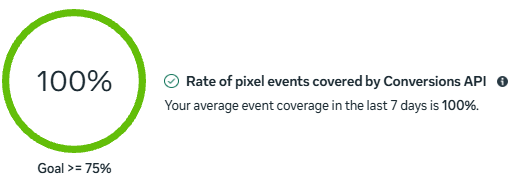
of browser pixel events also covered by the Conversions API — 7-day average. Meta’s goal line is ≥75%.

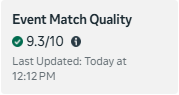
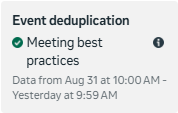
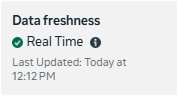
Measured on a live PrestaShop store running PrestaSignal — Meta Events Manager, September 2026.
How Meta Conversions API works on PrestaShop
Every step of the journey reaches Meta through the Conversions API: browsing events travel through the connector on your shop’s own address, and the purchase itself is reported by your back office — a server-to-server road that App Tracking Transparency and ad blockers never touch. The module builds the _fbc click cookie from the fbclid URL parameter when the shopper arrives from a Meta ad and the cookie is missing, forwards the _fbp browser cookie, and adds an external_id (a hashed reference to the customer) so Meta can match the conversion across devices and sessions.
If you also run the Meta pixel, both the pixel purchase and the CAPI purchase carry the same event ID, built from the order itself. Meta uses that shared ID to deduplicate, so a conversion seen by both is counted once — you get the pixel’s richness plus the server channel’s resilience, without inflating results. Throughout, your CAPI access token is used only on the server and is never written into page HTML, so it can’t be scraped from your site.
What the pixel alone misses
App Tracking Transparency strips the pixel of a large share of events from iPhone shoppers.
Browser blockers prevent the pixel from firing at all for a meaningful slice of traffic.
Without _fbc construction and external_id, Meta has fewer signals to match a conversion to a person.
Fewer events means smaller, staler Advantage+ and retargeting audiences to optimise against.
Meta CAPI server-side — questions.
Does this fix the iOS 14 conversion drop?+
It directly addresses it. The purchase reaches Meta through the Conversions API from your back office — a server-to-server road that doesn’t pass through the browser at all — recovering the sales the pixel alone loses on iOS.
Will the pixel and CAPI double-count my conversions?+
No. Both carry a shared event ID built from the order, and Meta uses it to deduplicate — a purchase seen by both the pixel and CAPI is counted exactly once.
Is my CAPI token exposed on the website?+
Never. The token is used only server-side and is never placed in page HTML or any browser script, so it can’t be scraped.
What’s external_id and why does it matter?+
It’s a hashed reference to the customer that helps Meta match conversions across devices and sessions, improving attribution beyond what cookies alone can do.
Do I still need the Meta pixel if I have CAPI?+
Pixel + CAPI together is the strongest setup, and PrestaSignal runs both as one design: the pixel served from your own address for rich browser context, CAPI from the server so the sale always arrives — with a shared event ID so Meta counts it once.
How do I verify events are arriving in Meta?+
Meta’s Events Manager has a Test Events tool, and the module supports a test event code so you can confirm server-side events land correctly before going fully live.
Recover the Meta conversions iOS took.
A free teardown shows what your pixel is missing and what CAPI would recover.